
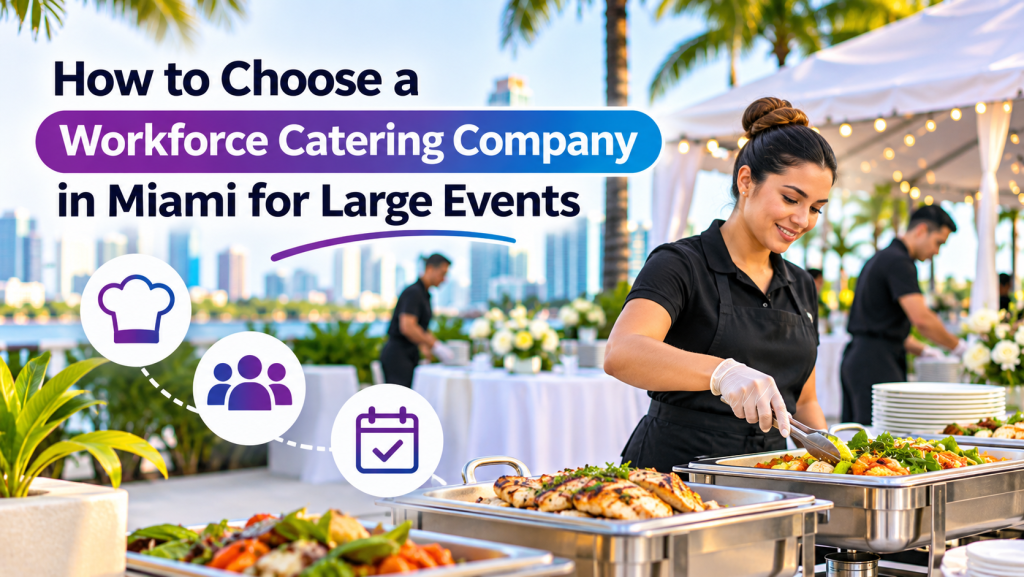
Organizing a large event in Miami requires more than selecting a venue, arranging food, and preparing a guest list. Behind every successful conference, corporate gathering, wedding reception, banquet, or large-scale celebration is a team responsible for keeping food service and guest operations running smoothly.
When hundreds or thousands of attendees are expected, having enough qualified servers, bartenders, kitchen staff, banquet personnel, and event support workers becomes a major operational concern. A shortage of workers can slow food service, create longer guest wait times, increase pressure on existing employees, and disrupt the event schedule.
This is why choosing the right workforce catering company in Miami matters. Event planners, catering businesses, hospitality operators, and venue managers need a staffing partner that understands the demands of large events and can provide the right people for specific responsibilities.
However, not every catering or staffing provider offers the same services. Some businesses prepare and deliver food, while others specialize in supplying the workforce that supports catering and hospitality operations.
Understanding this distinction can help businesses choose a partner that fits their event requirements, staffing volume, and schedule.
1. Understand the Difference Between Catering Services and Catering Workforce Staffing
Before comparing providers, clarify what type of support your event actually needs.
A traditional catering company generally focuses on food preparation, menu planning, delivery, presentation, and food service. Depending on the package, it may also provide servers, bartenders, kitchen personnel, and event coordination.
A workforce catering company or hospitality staffing provider focuses on supplying qualified personnel to support food service and event operations. Its responsibilities may include recruiting, screening, assigning, and coordinating workers for temporary or recurring staffing needs.
For example, a large corporate event in Miami may already have a food and beverage supplier but still require additional personnel to manage service stations, guest tables, beverage areas, and kitchen operations.
In that situation, a workforce staffing partner can help fill the labor requirements without requiring the event organizer to recruit every temporary worker independently.
Before requesting a proposal, identify whether you need:
- Complete catering services, including food preparation and service
- Temporary servers and banquet personnel
- Bartenders and beverage service staff
- Kitchen assistants and line cooks
- Dishwashing and back-of-house support
- Setup, breakdown, and event support crews
- Additional workers for peak service periods
Defining the scope first makes it easier to compare providers based on the services they actually deliver.
2. Evaluate the Company’s Experience With Large Events
Staffing a small private gathering is different from supporting a major conference, corporate reception, convention, or multi-day event.
Large events often involve multiple service areas, strict operating schedules, changing attendance numbers, and several teams working simultaneously. A staffing provider should understand how to organize personnel around these requirements.
Ask potential providers about their experience with:
Corporate events and conferences: These may require registration support, hospitality personnel, banquet servers, and food service teams working within fixed program schedules.
Weddings and large receptions: Staffing requirements can include table service, beverage stations, bartenders, banquet supervisors, and cleanup personnel.
Trade shows and conventions: These events may need workers across multiple rooms, food stations, service areas, and operating shifts.
Concerts and sporting events: High attendance and concentrated service periods can create significant demand for food service and hospitality workers.
Hotels and banquet facilities: Recurring functions may require flexible staffing for breakfast service, banquets, private dining, and special events.
Request examples of similar assignments and clarify which staffing responsibilities the provider handled. Experience supplying banquet servers is useful, but a large event may also require kitchen personnel, supervisors, and support workers.
A company with relevant event experience is more likely to understand the importance of preparation, communication, and workforce coordination.
3. Check Whether the Provider Can Supply the Right Staff Roles
One of the most important evaluation factors is the provider’s ability to match workers to specific job responsibilities.
Large catering operations need more than a general group of temporary workers. Each position has different duties, experience requirements, and service expectations.
Common event catering positions include:
Servers and Banquet Staff
Servers help deliver food and beverages, assist guests, clear tables, and maintain service standards. Banquet personnel may also help prepare dining areas and support coordinated meal service.
Bartenders
Bartenders handle beverage preparation and service, maintain bar stations, and interact with guests. For events involving alcohol, confirm that workers meet applicable training, age, and legal requirements.
Kitchen Staff and Line Cooks
Kitchen personnel support food preparation, cooking, plating, and kitchen organization. Their responsibilities should match the menu, service volume, and expectations of the catering operation.
Dishwashing and Utility Workers
Back-of-house support staff help manage dishes, utensils, equipment, and kitchen cleanliness. These roles are especially important when service continues across several hours or multiple meal periods.
Banquet Supervisors and Team Leaders
Supervisors help coordinate workers, communicate assignments, monitor service progress, and address operational concerns during the event.
When evaluating a workforce catering company in Miami, ask whether it can supply the combination of roles your event requires instead of offering only general hospitality labor.
Workforce Brokers provides hospitality and food service staffing that includes servers, bartenders, kitchen staff, and banquet and catering teams. These staffing categories can support businesses that need additional personnel for hospitality operations and large events.
4. Assess Workforce Capacity and Scalability
A staffing provider should be able to explain how it will meet your event’s labor requirements.
For a large gathering, the number of workers needed depends on several factors, including:
- Expected guest attendance
- Number of service stations and dining areas
- Type of food and beverage service
- Number of event hours and shifts
- Kitchen workload and meal preparation requirements
- Venue layout and distance between service areas
- Setup, breakdown, and cleanup responsibilities
Do not rely on a general promise to provide enough workers. Request a staffing plan that identifies the number of people assigned to each role and how the team will be organized.
For example, a corporate banquet may require separate groups for food service, beverage stations, kitchen operations, dishwashing, and guest support. A conference with several meal periods may also require shift coverage to prevent fatigue and maintain service consistency.
Ask the staffing provider:
- How many workers can be assigned to the event?
- Can additional personnel be supplied if attendance increases?
- Are workers available for multiple shifts?
- Can the company support simultaneous events?
- Who manages the assigned workforce?
- What is the backup plan if a scheduled worker cannot report?
Scalability is particularly important during Miami’s busy event periods, when hotels, convention facilities, corporate venues, and hospitality businesses may compete for available workers.
A workforce partner should provide realistic staffing commitments based on availability, job requirements, and deployment timelines.
5. Review Screening, Experience, and Food Safety Practices
The appearance and conduct of event staff directly influence the guest experience. However, professional presentation alone is not enough. Workers should also understand their assigned responsibilities and follow the required workplace procedures.
Ask how the staffing company evaluates candidates before assigning them to an event.
Important considerations include:
Relevant experience: Has the worker performed similar duties in a restaurant, hotel, banquet facility, catering operation, or event venue?
Skills verification: Does the provider assess practical abilities relevant to the assigned position?
Food safety awareness: Are workers assigned to food-handling roles familiar with applicable hygiene and food safety procedures?
Communication: Can staff follow instructions, coordinate with supervisors, and communicate effectively with guests and other team members?
Professional conduct: Does the provider establish expectations for punctuality, appearance, and workplace behavior?
Food safety deserves particular attention when assigning kitchen and food-handling personnel. The Florida Department of Health provides information on food safety and sanitation, while the FDA Food Code offers a model framework used by regulatory authorities when developing food safety requirements.
Requirements can differ by role and jurisdiction, so confirm which training, permits, or certifications are required for your specific operation. Do not assume every temporary worker needs the same credential.
6. Evaluate Scheduling, Attendance, and Workforce Management
Even a qualified staffing team can create problems if workers arrive late, receive unclear instructions, or are assigned to the wrong service areas.
Large events depend on precise timing. Staff may need to report before guests arrive for setup, attend briefings, prepare service stations, and remain available until cleanup is completed.
Ask how the staffing provider manages the following:
Pre-event confirmation: Are assignments, reporting times, locations, and job responsibilities confirmed before the event?
Attendance monitoring: How does the company verify that workers have arrived and are ready to begin?
Shift coordination: Can the provider manage staggered shifts and scheduled breaks?
On-site supervision: Is there a designated contact or team leader responsible for communicating with event management?
Issue resolution: What happens if workers are absent, delayed, or unable to perform their assigned duties?
Post-event reporting: Can the provider supply attendance records, hours worked, and other requested workforce information?
Workforce Brokers uses its EDGE™ technology to support workforce tracking and management. The platform provides attendance and performance insights that can help businesses monitor assigned personnel and evaluate workforce operations.
For companies managing several event areas or recurring assignments, having access to workforce information can make staffing coordination more organized.
7. Consider Miami’s Event Locations and Operational Requirements
Miami’s event market includes hotels, convention facilities, corporate venues, private properties, and outdoor event spaces. Each location can create different staffing and logistical requirements.
A conference near Downtown Miami may have different access and reporting arrangements from a private event in Coral Gables or a large hospitality function in Miami Beach.
Before hiring a staffing provider, share the venue address and relevant operational details.
Discuss:
- Worker arrival and check-in procedures
- Parking and transportation arrangements
- Loading and service entrance access
- Staff uniform and appearance requirements
- Venue orientation and safety instructions
- Kitchen access and service-area restrictions
- Setup and breakdown schedules
- Communication with the venue’s management team
Weather and seasonal demand can also affect event operations in South Florida. Outdoor events may require contingency planning for heat, rain, and changes to the event layout.
A staffing partner should understand that deployment involves more than sending workers to an address. Personnel need clear instructions about where to report, who to contact, and what they are expected to do.
Workforce Brokers maintains a Miami office at 821 Northwest 37th Avenue, Miami, FL 33125, supporting its staffing operations in the local market.
8. Compare Pricing, Contracts, and Staffing Terms
Price is important, but the lowest hourly rate does not necessarily represent the best staffing arrangement.
A proposal should explain what the client receives and how additional requirements are handled.
Compare the following:
- Hourly rates by position
- Minimum shift or booking hours
- Overtime policies
- Setup and breakdown coverage
- Transportation or travel charges, if applicable
- Cancellation and rescheduling terms
- Last-minute staffing requests
- Replacement procedures for absent workers
- Supervisory and management fees
- Billing and payment arrangements
Make sure the provider distinguishes between the cost of staffing and the cost of food, beverages, equipment, and catering supplies. A workforce staffing agreement may cover labor only, while a full-service catering contract can include several additional services.
Ask for written confirmation of the staffing scope, scheduled hours, responsibilities, and procedures for requesting changes.
Clear terms help prevent misunderstandings and make it easier to calculate the actual cost of supporting the event.
9. Look for a Workforce Partner That Can Support Changing Event Demands
Large events rarely operate without adjustments. Attendance may increase, schedules can shift, service areas may expand, and additional workers may be needed during peak periods.
A staffing partner should be able to communicate clearly when changes occur and explain what additional support is available.
Workforce Brokers has more than 25 years of experience in staffing and workforce solutions, including hospitality, food service, and event operations. Its hospitality staffing services cover front-desk and concierge personnel, servers and bartenders, kitchen staff, and banquet and catering teams.
The company also offers workforce solutions for events and special-event operations, including staffing support for conferences, concerts, trade shows, and other event settings.
For businesses evaluating staffing options, it is useful to understand how a provider handles both hospitality assignments and broader event workforce requirements.
You can also explore the industries Workforce Brokers serves to learn more about its staffing capabilities.
Why Consider Workforce Brokers for Catering and Event Staffing in Miami?
For event organizers, hospitality businesses, and catering operators, finding enough qualified workers is only part of the challenge. The workforce must also be organized, deployed on time, and supported throughout the assignment.
Workforce Brokers provides hospitality and food service staffing solutions for businesses that need personnel for catering, hotels, restaurants, and event venues.
Its services include:
- Servers and bartenders
- Kitchen staff and line cooks
- Banquet and catering teams
- Front-desk and concierge personnel
- Hospitality workforce support
- Workforce tracking through EDGE™ technology
The company highlights more than 25 years of staffing experience, candidate screening, and rapid deployment capabilities. Actual availability and deployment timelines depend on the event’s staffing requirements, location, and workforce needs.
For large events in Miami, discuss the expected attendance, service format, job roles, shift schedule, and required staffing volume with the team.
Visit Workforce Brokers to explore its services or contact the company to discuss your event staffing requirements.
Frequently Asked Questions
1. What should I look for in a workforce catering company in Miami?
Look for a provider with relevant hospitality and event staffing experience, access to qualified servers and kitchen personnel, workforce capacity, screening procedures, attendance management, and clear contract terms. Confirm that its services match your actual staffing requirements.
2. How many catering staff members are needed for a large event?
The number depends on guest attendance, service style, menu complexity, venue layout, event duration, and the number of service stations. Request a staffing assessment that separates servers, bartenders, kitchen personnel, supervisors, and support workers.
3. Can a workforce staffing company provide temporary servers and bartenders in Miami?
Yes. Hospitality staffing providers may supply temporary servers, bartenders, banquet personnel, and other event workers. Confirm role availability, experience requirements, scheduling, and any applicable training or licensing requirements before booking.
4. What is the difference between a catering company and a catering staffing agency?
A catering company generally provides food preparation, menu planning, delivery, and food service. A catering staffing agency focuses on supplying workers who support these operations. Some providers offer both, so clarify whether the agreement includes food services, labor, or both.
5. How far in advance should I book catering staff for a large Miami event?
The ideal lead time depends on event size, staffing volume, season, and job requirements. Larger events and peak-demand periods generally benefit from earlier planning. Share the event date, venue, estimated attendance, and staffing plan as soon as possible so the provider can assess availability.
Final Thoughts
Choosing a workforce catering company in Miami requires more than finding enough people to fill a schedule. Businesses need workers with the right experience, clear assignments, dependable attendance, and the ability to support the pace of large-scale hospitality operations.
Before selecting a provider, evaluate its staffing capabilities, workforce capacity, screening practices, scheduling systems, pricing structure, and experience with comparable events.
For event organizers, catering operators, and hospitality businesses in Miami, Workforce Brokers offers staffing solutions that include servers, bartenders, kitchen personnel, and banquet and catering teams. Discuss your event requirements with the team to determine the workforce support needed for a well-coordinated operation.